

How to Sharpen Lawn Mower Blades at Home
Table of Contents
- What You'll Need Before You Start
- How to Remove Lawn Mower Blade Safely
- Signs Your Lawn Mower Blade Is Dull
- Best Tools for Sharpening Mower Blades
- Step-by-Step Process to Sharpen Your Blade
- How to Balance Lawn Mower Blades
- When to Replace Instead of Sharpen
- Common Mistakes to Avoid
- Frequently Asked Questions
Last Updated: October 7, 2026
What You'll Need Before You Start
Learning how to sharpen lawn mower blades at home requires just a few basic tools and supplies. You don't need an expensive workshop or professional equipment to do this job well.
Here's what you'll gather before starting:
- Socket wrench or wrench set to remove the blade bolt
- File or grinder to sharpen the cutting edge
- Vise or clamp to hold the blade steady
- Work gloves for safety and grip
- Protective eyewear to shield from metal shavings
- Hearing protection if using a power grinder
- Spark plug socket or similar tool to disconnect the spark plug
- Workbench or sturdy table for your workspace
- Cleaning cloth or brush to remove grass and debris
- Blade balancer (optional but helpful for checking your work)
The Corona Sharpening Tool is an excellent choice for this job. It's a 5-inch carbide file designed specifically for straight blades and fits easily in your pocket or tool storage. The non-slip grip makes it comfortable to use for extended sharpening sessions.

If you prefer a multi-purpose option, the Zenport 6-in-1 Multi-Sharpener works on pruners, scissors, and knives too. It includes a built-in safety hand guard and comes with cleaning supplies stored right in the handle.
For those building a complete toolkit, the 53 Piece Household Tool Kit from DIY HomeEssentials includes most of the wrenches and basic tools you'll need. It comes in a sturdy storage case, so everything stays organized and ready when you need it.
How to Remove Lawn Mower Blade Safely
Removing the blade safely is the most critical step in this entire process. A careless removal can lead to serious cuts or injuries.
Always disconnect the spark plug first. This prevents accidental starting while you work. Simply remove the spark plug wire or battery terminal. Wait a few minutes for any residual energy to dissipate.
Tip the mower on its side with the carburetor facing up. This prevents oil from leaking into the air filter.
Locate the blade bolt at the center of the blade. Use your socket wrench to loosen it. Some bolts turn clockwise to loosen; others turn counterclockwise.
Hold the blade steady with one hand while turning the wrench with the other. Never let the blade spin freely.
Slide the blade off the shaft. Inspect the mounting area for damage or corrosion. If the shaft looks damaged, you may need professional service before reinstalling the blade.
Signs Your Lawn Mower Blade Is Dull
A dull blade tears grass instead of cutting it cleanly. This damage weakens your lawn and invites disease.
Check for ragged grass edges. Walk your lawn after mowing. Look at the cut grass tips with your eyes or a magnifying glass.
Listen to your mower. A dull blade requires more engine power to cut. Your mower sounds louder and works harder than usual.
Notice uneven cutting. If some areas look shorter than others, the blade may be dull or bent.
Check for visible damage. Look for nicks, dents, or worn spots along the cutting edge. Small nicks dull the blade faster.
Feel the blade edge. Wearing heavy gloves, carefully run your thumb along the blade edge (perpendicular to the edge, not along it).
Most homeowners sharpen their blades twice per season. If you mow frequently or on rough terrain, you may need more frequent sharpening.
Best Tools for Sharpening Mower Blades
You have several options for how to sharpen lawn mower blades, each with advantages and drawbacks.
Hand files are the most popular choice for home use. They're affordable, quiet, and give you complete control. A metal file or carbide file works well.
Angle grinders are faster but noisier and require more experience.
Bench grinders offer a middle ground. They're stationary, so your hands stay safer. They work faster than hand files.
Blade sharpeners designed specifically for lawn mower blades are available. Some mount in a vise. Others are handheld.
For most homeowners, a hand file is the best choice. The Zenport 6-in-1 Multi-Sharpener at $22.20 offers versatility if you plan to sharpen other tools too.

The key is choosing a tool you'll actually use. An expensive grinder gathering dust in the garage helps no one. Start simple with a hand file.
Step-by-Step Process to Sharpen Your Blade
Now for the actual sharpening work. This process takes about 15-20 minutes per blade.
Clean the blade thoroughly
Start by removing all grass, dirt, and debris from the blade. Use a stiff brush or cloth to scrub both sides. Pay special attention to the cutting edge and the underside where clippings accumulate.
Dried grass buildup hides damage and makes it harder to see what you're sharpening. A clean blade also helps you maintain consistent pressure while filing.
If the blade is very dirty, rinse it with water and let it dry completely before starting.
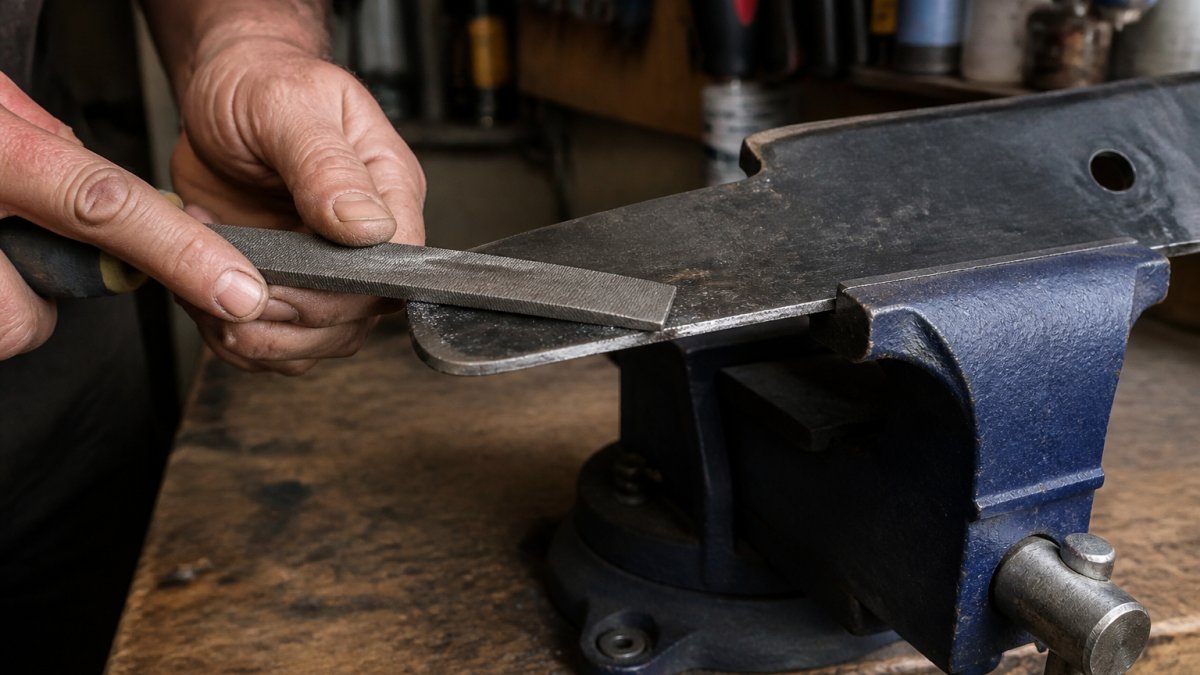
Secure the blade in a vise or clamp
Place the blade in a vise with the cutting edge facing up. Tighten the vise firmly so the blade doesn't move. The blade should be horizontal and stable.
Position the vise at a comfortable working height. You want your arms at roughly 90 degrees when filing. This reduces fatigue and gives you better control.
Never hold the blade in your hand while sharpening. Even with gloves, a slip can cause serious injury.
Follow the existing cutting angle
This is where most people make mistakes. The blade already has an angle. Your job is to maintain that angle, not create a new one.
Look at the blade edge closely. You'll see it's beveled at an angle. Most lawn mower blades are sharpened at 30 to 45 degrees. The exact angle depends on your blade design.
Place your file at the same angle as the existing bevel. If you're unsure of the exact angle, aim for roughly 30 degrees. This is steep enough to cut well but not so steep that the edge breaks easily.
Keep your file at this angle throughout the sharpening process. This consistency produces a blade that cuts smoothly.
File or grind both sides evenly
Start on one side of the blade. Make several firm strokes with your file, moving from the top of the blade toward the tip. Use smooth, controlled motions.
Count your strokes. After 10-15 strokes, switch to the other side of the blade. Make the same number of strokes on that side.
Alternate sides several times. This keeps the blade balanced and sharp on both sides. Sharpening only one side creates an unbalanced blade that vibrates during cutting.
Continue until both sides feel equally sharp. Run your thumb perpendicular to the edge (not along it) to check sharpness. The edge should feel fine and smooth, like a butter knife.
How to Balance Lawn Mower Blades
An unbalanced blade causes vibration, uneven cutting, and engine strain. Balancing takes just a few minutes and makes a huge difference.
A blade balancer is a simple tool. It's usually a cone or shaft that holds the blade at its center point.
If the blade is balanced, it stays level. If one side dips down, that side is heavier.
To fix an unbalanced blade, remove a bit more metal from the heavier side. Make just a few light strokes with your file. Rebalance and check again.
Continue adjusting until the blade hangs level on the balancer. This usually takes just a few minutes of fine-tuning.
If you don't have a blade balancer, you can improvise. Hang the blade on a nail through its center hole. Let it swing freely.
A balanced blade cuts evenly, reduces vibration, and extends engine life. It's worth taking the time to get this right.
When to Replace Instead of Sharpen
Sometimes sharpening isn't the answer. A damaged blade is safer to replace than to repair.
Replace the blade if it has large cracks. Cracks grow during use and can cause blade failure.
Replace if the blade is severely bent. A bent blade vibrates badly and can't be straightened safely at home.
Replace if there are large chunks missing. If more than a small notch is gone, sharpening won't help.
Replace if the blade is very thin. After years of sharpening, blades wear down.
Replace if the bolt hole is damaged. If the center hole is cracked or enlarged, the blade won't mount securely.
A new blade costs between $20 and $50 depending on your mower. This is cheap insurance against injury or engine damage.
Most blades last 1-3 seasons with regular sharpening. If you've sharpened the same blade many times, replacement is probably overdue.
Common Mistakes to Avoid
Even experienced people make sharpening mistakes. Here's what to watch for.
Don't sharpen at the wrong angle. Sharpening at too steep an angle creates a blade that dulls quickly.
Don't sharpen one side more than the other. This creates an unbalanced blade.
Don't skip the balancing step. An unbalanced blade causes vibration and engine strain.
Don't over-sharpen the blade. You want a sharp edge, not a razor edge.
Don't forget to disconnect the spark plug. This is the most important safety step.
Don't reinstall the blade upside down. Mark which side faces down before removal. Reinstall it the same way.
Don't skip the cleaning step. Dried grass hides damage and makes sharpening harder. Clean the blade thoroughly before starting.
Don't sharpen a bent or cracked blade. These need replacement, not sharpening.
At DIY HomeEssentials, we help homeowners tackle maintenance like this with confidence.
Frequently Asked Questions
How often should you sharpen your lawn mower blades?
Most homeowners should sharpen lawn mower blades every 20 to 40 hours of mowing, roughly every 4 to 8 weeks during the growing season. If you mow frequently or have a large lawn, sharpen more often. Dull blades tear grass rather than cut it cleanly, which stresses the plant and invites disease. Check your blade's condition every few weeks, if it's no longer sharp to the touch or your mower produces an uneven cut, it's time to sharpen.
What tools do I need to sharpen mower blades at home?
You'll need a metal file, angle grinder, or specialized blade sharpener; a vise or clamp to secure the blade; a socket wrench or adjustable wrench to remove the blade bolt; safety gear including work gloves, protective eyewear, and hearing protection if using a grinder; and a blade balancer to check weight distribution. The Corona Sharpening Tool is a 5-inch carbide file ideal for straight blades, while a 53-piece or 170-piece household tool kit includes wrenches and other essentials you may need.
Can you sharpen lawn mower blades without taking them off?
It's technically possible but not recommended. Sharpening a blade while attached to the mower is unsafe, difficult to control, and risks damaging the mower deck or yourself. Removing the blade gives you full access to both cutting edges, lets you secure it firmly in a vise, and allows proper balancing. Always disconnect the spark plug wire and battery before removing the blade to prevent accidental start-up.
Are lawn mower blades worth sharpening?
Yes, sharpening is worth the effort and cost. A sharp blade produces a clean cut that keeps grass healthy and reduces disease risk. Dull blades tear the grass, turning leaf tips brown and weakening the plant. Sharpening costs far less than blade replacement and takes 30 to 45 minutes at home. If a blade is cracked, severely bent, or has large chips, replacement is the only safe option, but most dull blades benefit from sharpening.
Keeping your lawn mower blade sharp is one of the easiest home maintenance tasks you can do. A sharp blade cuts cleanly, reduces engine strain, and keeps your lawn healthy. With the right tools and techniques, you'll have professional results in under an hour. DIY HomeEssentials carries all the hand tools and sharpening equipment you need to complete this job safely and effectively.